
This study is a multi-jurisdictional two-year effort to create a shared vision for the future of the Stevens Creek Boulevard Corridor. The study will gather input from community members on challenges and opportunities they see on the corridor. Those insights will be used to develop a vision for the corridor in addition to steps to reach that vision. This will include recommendations on how to direct transportation investment from the cities of San José, Santa Clara, Cupertino, the county and VTA.
This Vision Study builds on previous transportation planning efforts and seeks to harmonize shared values in the corridor so future transportation investment in infrastructure and services can be coordinated across the different cities, the County, and VTA.
Background
The Stevens Creek Boulevard Corridor is a major health, education, tech industry, shopping and housing spine in the South Bay. It is experiencing significant growth in commercial and residential land uses. In 2019, the cities of Cupertino, Santa Clara, San José, and Santa Clara County adopted resolutions in support of a vision study of the Stevens Creek Boulevard Corridor to create a common vision for mobility to enhance quality of life for all community members. Additionally, regional funding for a high-capacity transit service on Stevens Creek was included as part of the Metropolitan Transportation Commission’s (MTC)’s Regional Transportation Plan after a joint submission by corridor agencies. A steering committee of elected officials corridor jurisdictions formed to provide a forum for elected representatives to meet, discuss and provide direction on a common vision for the Stevens Creek Corridor.
In February 2022, the City of Cupertino formally joined the study effort, with a particular interest in considering the potential for transit options that do not impact general purpose lanes or vehicular capacity on City surface streets, as well as the direction to extend the study limits to Foothill Boulevard.
The Stevens Creek Boulevard Vision Study began in January 2023, and the Engagement Plan was approved by the Steering Committee in June 2023, which began the formal outreach process for the Study.
About the Corridor
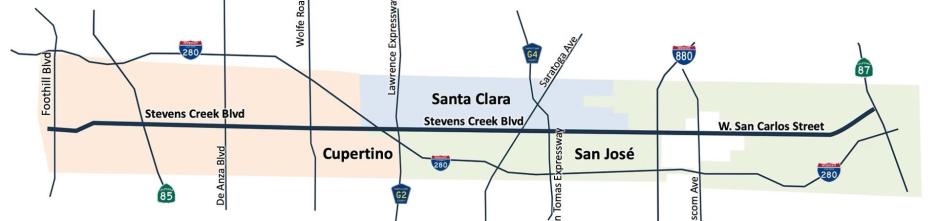
The Stevens Creek Boulevard Corridor, beginning along West San Carlos Street near Diridon Station and extending to the west to Highway 85, is a major artery that connects regional job centers focusing on health, education, and tech to housing and commercial areas. Prominent sites along the corridor include De Anza College, Main Street Cupertino, Apple headquarters, Agilent Technologies headquarters, San José City College, Santa Clara Valley Medical Center, five San José Urban Villages – one of which includes the Santana Row/Valley Fair shopping district, new West San José Innovation Zone and a “Future Focus Area” in the City of Santa Clara.
Get Involved
One of the main goals of this study is to hear from many voices from the community. The Stevens Creek Boulevard Corridor includes a rich diversity of businesses and community members. The Project Team is dedicated to meeting with interested stakeholders to better understand challenges people face traveling within the corridor. We are committed to creating an inclusive vision for a safe and convenient connection between Cupertino, Santa Clara, and San José.
| Phase One: Needs |
Phase Two: Vision Development |
Phase Three: Alternatives |
Phase Four: Final Vision & Implementation Plan |
|---|---|---|---|
| Summer 2023 | Winter 2023 | Spring 2024 | Fall 2024 |
|
|
|
|
Additional Project Information
What is the purpose of the Stevens Creek Boulevard Corridor Vision Study?
The Stevens Creek Boulevard Corridor Vision Study developed goals for the corridor to guide future investments in transportation. The Study was guided by a comprehensive community engagement process. The Stevens Creek Boulevard Corridor goes through the cities of Cupertino, Santa Clara and San José. Management, operations, and improvements are the responsibility of these cities in addition to the County of Santa Clara and Valley Transportation Authority (VTA). Each agency acknowledges the importance of the corridor and the need for a shared vision for the future.
What are the different possible futures for the corridor?
We had an open visioning process for transportation options in the corridor. Possible futures included improvements to all modes of travel–walking, biking, driving, transit, and potentially new ways to get around.
What is the Vision Study schedule?
The Vision Statement was developed through the end of 2023 and work on the Implementation Plan began in 2025. The development of these components included four phases:
Phase 1 Needs - Learning about transportation needs and challenges in the corridor through outreach and technical analysis.
Phase 2 Vision Development - Creation of a vision by reviewing the needs identified in Phase 1.
Phase 3 Alternatives - Development and review of potential improvements.
Phase 4 Final Vision and Implementation Plan - Creation of a planning document that serves as a roadmap for implementing the vision.
What are the benefits of a Vision Statement?
Implementing meaningful transportation improvements takes support from the community, agency staff and elected officials. When there is a clear vision for the future there is a clear purpose for each step in the implementation process. Comprehensive community engagement was key in the creation of the Vision Statement, Implementation Plan, and the long-term success of the corridor.
What area is part of the Stevens Creek Boulevard Corridor Vision Study?
The west edge of the study area was Stevens Creek Boulevard at Foothill Boulevard in Cupertino. From there, the corridor followed Stevens Creek Boulevard through Cupertino and Santa Clara to San José. In San José, the corridor followed Stevens Creek to where it becomes West San Carlos Street until that street intersects Barack Obama Boulevard in San José. North/south connections were part of the Study to help inform how the Stevens Creek Boulevard Corridor should connect to other existing and future transportation corridors.
How is the Vision Study process funded?
The Vision Study was cooperatively funded by VTA, Santa Clara County, and the cities of Cupertino, Santa Clara and San José. The VTA portion of the funding is specifically tied to improvements to bus speed and reliability, which were specific components of the technical analysis of the Vision Study.
Who makes the decisions?
The Study included a Working Group of agency staff and the consultant team that met on a biweekly basis. This Working Group reviewed community input and technical materials in detail. A Steering Committee of elected official designees from the Corridor agencies were scheduled to meet quarterly during the study process to approve Vision Study and Implementation Plan deliverables. Ultimately, each City Council, the County Board of Supervisors, and the VTA Board of Directors were requested to take action on the Vision Statement and Implementation Plan
Who is working on the project?
The Vision Study was a collaborative process of stakeholders facilitated by a team of consultants from the firms Iteris and Winter Consulting. Stakeholders included agency staff and elected officials from the participating agencies as well as community members, businesses, and corridor users.
Background Material
City of Cupertino Memo and Resolution
City of San José Memo and Resolution
City of Santa Clara Memo and Resolution
County of Santa Clara Memo and Resolution
Foothill-De Anza Board of Trustees Resolution
This study is a multi-jurisdictional two-year effort to create a shared vision for the future of the Stevens Creek Boulevard Corridor. The study will gather input from community members on challenges and opportunities they see on the corridor. Those insights will be used to develop a vision for the corridor in addition to steps to reach that vision. This will include recommendations on how to direct transportation investment from the cities of San José, Santa Clara, Cupertino, the county and VTA.
This Vision Study builds on previous transportation planning efforts and seeks to harmonize shared values in the corridor so future transportation investment in infrastructure and services can be coordinated across the different cities, the County, and VTA.
Background
The Stevens Creek Boulevard Corridor is a major health, education, tech industry, shopping and housing spine in the South Bay. It is experiencing significant growth in commercial and residential land uses. In 2019, the cities of Cupertino, Santa Clara, San José, and Santa Clara County adopted resolutions in support of a vision study of the Stevens Creek Boulevard Corridor to create a common vision for mobility to enhance quality of life for all community members. Additionally, regional funding for a high-capacity transit service on Stevens Creek was included as part of the Metropolitan Transportation Commission’s (MTC)’s Regional Transportation Plan after a joint submission by corridor agencies. A steering committee of elected officials corridor jurisdictions formed to provide a forum for elected representatives to meet, discuss and provide direction on a common vision for the Stevens Creek Corridor.
In February 2022, the City of Cupertino formally joined the study effort, with a particular interest in considering the potential for transit options that do not impact general purpose lanes or vehicular capacity on City surface streets, as well as the direction to extend the study limits to Foothill Boulevard.
The Stevens Creek Boulevard Vision Study began in January 2023, and the Engagement Plan was approved by the Steering Committee in June 2023, which began the formal outreach process for the Study.
About the Corridor
The Stevens Creek Boulevard Corridor, beginning along West San Carlos Street near Diridon Station and extending to the west to Highway 85, is a major artery that connects regional job centers focusing on health, education, and tech to housing and commercial areas. Prominent sites along the corridor include De Anza College, Main Street Cupertino, Apple headquarters, Agilent Technologies headquarters, San José City College, Santa Clara Valley Medical Center, five San José Urban Villages – one of which includes the Santana Row/Valley Fair shopping district, new West San José Innovation Zone and a “Future Focus Area” in the City of Santa Clara.
Get Involved
One of the main goals of this study is to hear from many voices from the community. The Stevens Creek Boulevard Corridor includes a rich diversity of businesses and community members. The Project Team is dedicated to meeting with interested stakeholders to better understand challenges people face traveling within the corridor. We are committed to creating an inclusive vision for a safe and convenient connection between Cupertino, Santa Clara, and San José.
| Phase One: Needs |
Phase Two: Vision Development |
Phase Three: Alternatives |
Phase Four: Final Vision & Implementation Plan |
|---|---|---|---|
| Summer 2023 | Winter 2023 | Spring 2024 | Fall 2024 |
|
|
|
|
Additional Project Information
What is the purpose of the Stevens Creek Boulevard Corridor Vision Study?
The Stevens Creek Boulevard Corridor Vision Study developed goals for the corridor to guide future investments in transportation. The Study was guided by a comprehensive community engagement process. The Stevens Creek Boulevard Corridor goes through the cities of Cupertino, Santa Clara and San José. Management, operations, and improvements are the responsibility of these cities in addition to the County of Santa Clara and Valley Transportation Authority (VTA). Each agency acknowledges the importance of the corridor and the need for a shared vision for the future.
What are the different possible futures for the corridor?
We had an open visioning process for transportation options in the corridor. Possible futures included improvements to all modes of travel–walking, biking, driving, transit, and potentially new ways to get around.
What is the Vision Study schedule?
The Vision Statement was developed through the end of 2023 and work on the Implementation Plan began in 2025. The development of these components included four phases:
Phase 1 Needs - Learning about transportation needs and challenges in the corridor through outreach and technical analysis.
Phase 2 Vision Development - Creation of a vision by reviewing the needs identified in Phase 1.
Phase 3 Alternatives - Development and review of potential improvements.
Phase 4 Final Vision and Implementation Plan - Creation of a planning document that serves as a roadmap for implementing the vision.
What are the benefits of a Vision Statement?
Implementing meaningful transportation improvements takes support from the community, agency staff and elected officials. When there is a clear vision for the future there is a clear purpose for each step in the implementation process. Comprehensive community engagement was key in the creation of the Vision Statement, Implementation Plan, and the long-term success of the corridor.
What area is part of the Stevens Creek Boulevard Corridor Vision Study?
The west edge of the study area was Stevens Creek Boulevard at Foothill Boulevard in Cupertino. From there, the corridor followed Stevens Creek Boulevard through Cupertino and Santa Clara to San José. In San José, the corridor followed Stevens Creek to where it becomes West San Carlos Street until that street intersects Barack Obama Boulevard in San José. North/south connections were part of the Study to help inform how the Stevens Creek Boulevard Corridor should connect to other existing and future transportation corridors.
How is the Vision Study process funded?
The Vision Study was cooperatively funded by VTA, Santa Clara County, and the cities of Cupertino, Santa Clara and San José. The VTA portion of the funding is specifically tied to improvements to bus speed and reliability, which were specific components of the technical analysis of the Vision Study.
Who makes the decisions?
The Study included a Working Group of agency staff and the consultant team that met on a biweekly basis. This Working Group reviewed community input and technical materials in detail. A Steering Committee of elected official designees from the Corridor agencies were scheduled to meet quarterly during the study process to approve Vision Study and Implementation Plan deliverables. Ultimately, each City Council, the County Board of Supervisors, and the VTA Board of Directors were requested to take action on the Vision Statement and Implementation Plan
Who is working on the project?
The Vision Study was a collaborative process of stakeholders facilitated by a team of consultants from the firms Iteris and Winter Consulting. Stakeholders included agency staff and elected officials from the participating agencies as well as community members, businesses, and corridor users.
Background Material
City of Cupertino Memo and Resolution
City of San José Memo and Resolution
City of Santa Clara Memo and Resolution
County of Santa Clara Memo and Resolution
Foothill-De Anza Board of Trustees Resolution